


“Turn on the tap, and out comes mineral water.”
This is a phrase often seen when speaking of the purity and delicious taste of Kumamoto’s tap water.
Furthermore, semiconductor manufacturers that require vast amounts of pure water for their cleaning processes—led by Taiwan Semiconductor Manufacturing Company (TSMC)—have chosen Kumamoto as the location for their factories and established a presence here.
So, where does Kumamoto’s abundant, pure, and delicious water actually come from?
In 2013, Kumamoto City’s groundwater conservation initiatives were highly recognized, making it the first Japanese city to win the United Nations’ top “Water for Life” Best Practices Award.
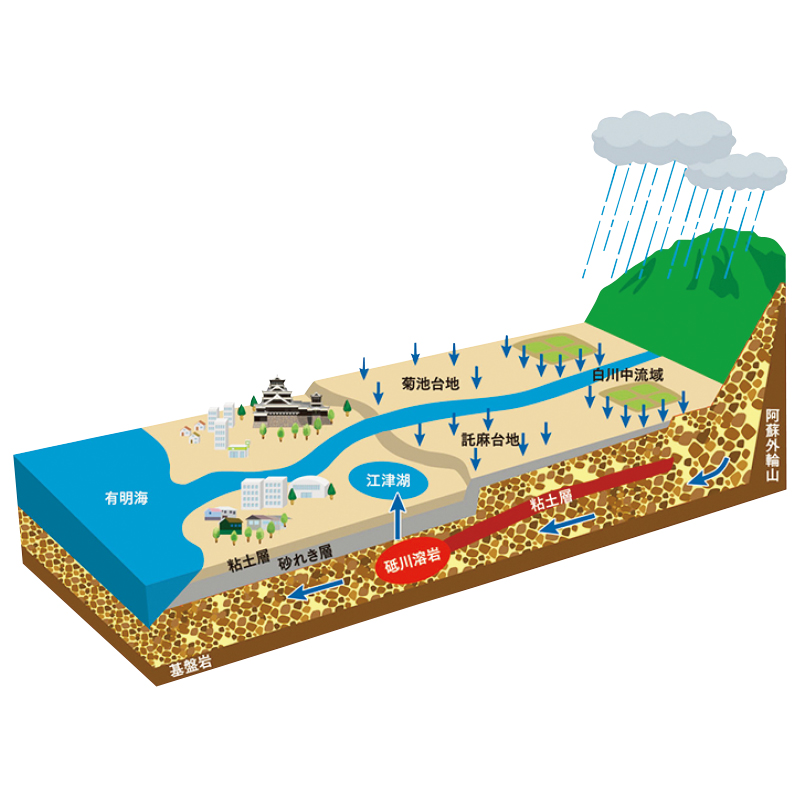
Groundwater System Diagram of the Kumamoto Region
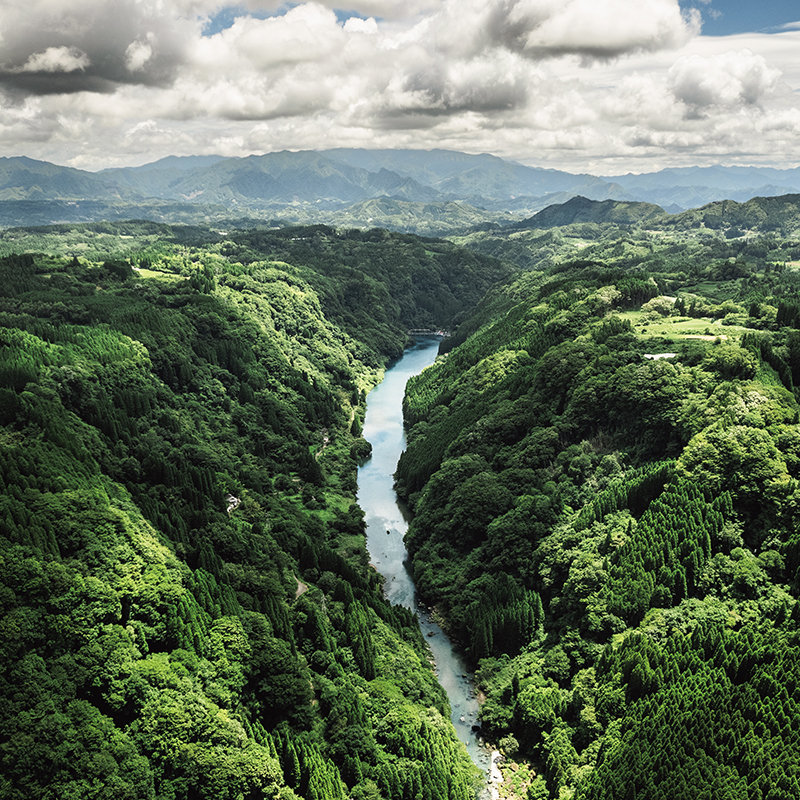
It flows from the outer rim of Mount Aso, through the midstream area of the Shirakawa River, and reaches the area around Lake Ezu in the heart of Kumamoto City.
Image courtesy of the Water Conservation Division, Kumamoto City
Kumamoto’s groundwater.
The secret to its abundance.
Did you know that Kumamoto is a region with exceptionally heavy rainfall, even compared to the rest of Japan? While Japan’s average annual precipitation is 1,700 mm, Kumamoto receives as much as 2,000 mm, and Mount Aso sees an astonishing 3,000 mm of rainfall. This heavy rainfall lies behind the blessings of groundwater that Kumamoto enjoys.
However, heavy rainfall alone cannot fully explain the richness of Kumamoto’s groundwater. According to the Water Conservation Division of the Environmental Promotion Department at the Kumamoto City Environment Bureau, which promotes groundwater conservation efforts in Kumamoto, there are two main factors.
First, there is the natural blessing brought by the geological strata of Aso. Over many long years, Mount Aso experienced four major pyroclastic flow eruptions. As a result, thick layers of pyroclastic flow accumulated, forming rich geological strata beneath the Kumamoto region. Water easily permeates these strata, which are distributed in layers more than 100 meters thick. Furthermore, because there is hard bedrock underneath, the fallen rain is stored abundantly underground.
Second is the “recharge area” (the region where groundwater is created) brought about by Kato Kiyomasa, the famous builder of Kumamoto Castle. Kiyomasa devoted great effort to civil engineering and flood control as well. He promoted paddy field development, building weirs and irrigation canals in the midstream area of the Shirakawa River (around Ozu Town and Kikuyo Town) to open up large-scale rice paddies.
Because the soil in this area allowed water to permeate easily, vast amounts of rainwater seeped underground, further increasing the volume of groundwater. This rice paddy development was subsequently passed down by the descendants of the Kato and Hosokawa families. As a result, approximately 90 million cubic meters of groundwater are recharged in the midstream area of the Shirakawa River today.
In this way, the abundance of rain, the unique characteristics of the land, and human wisdom came together in the Kumamoto region to form today’s water cycle and rich groundwater system more than 400 years ago.
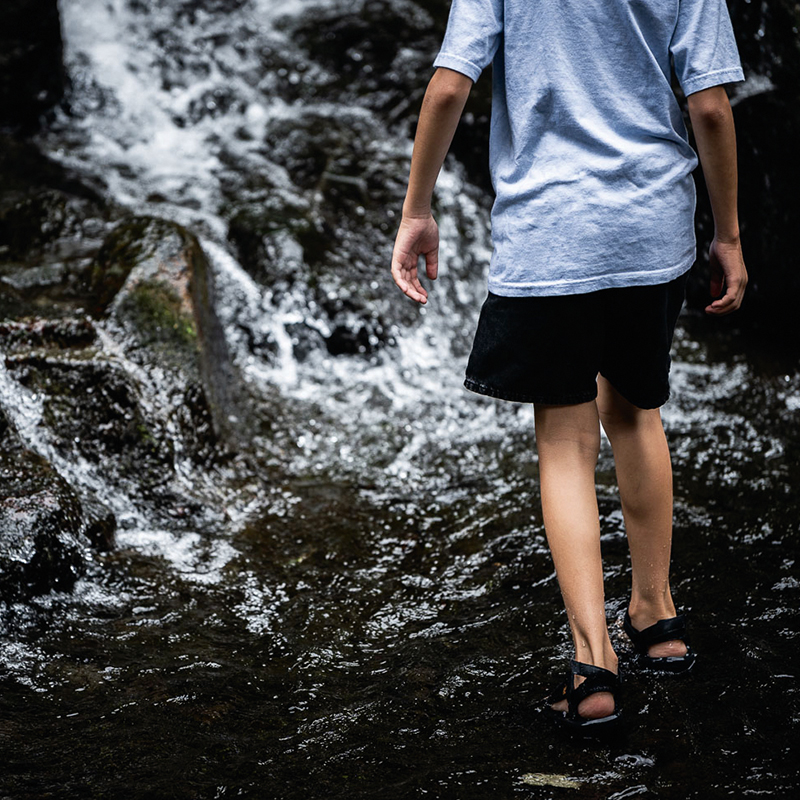
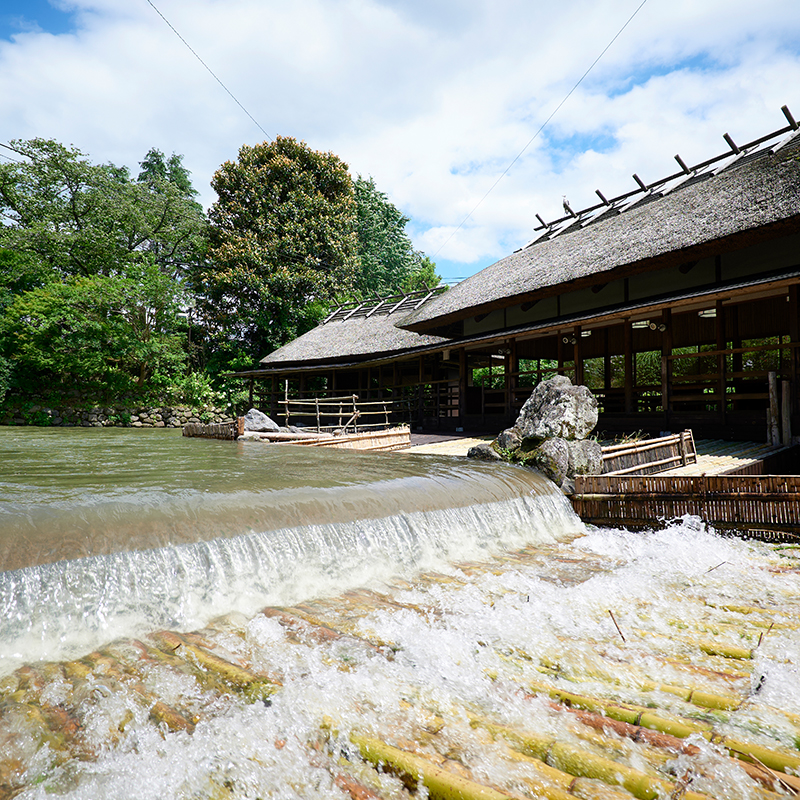
Playing in the water, relaxing by the water.
When you are in Kumamoto, you feel the closeness between people and water.
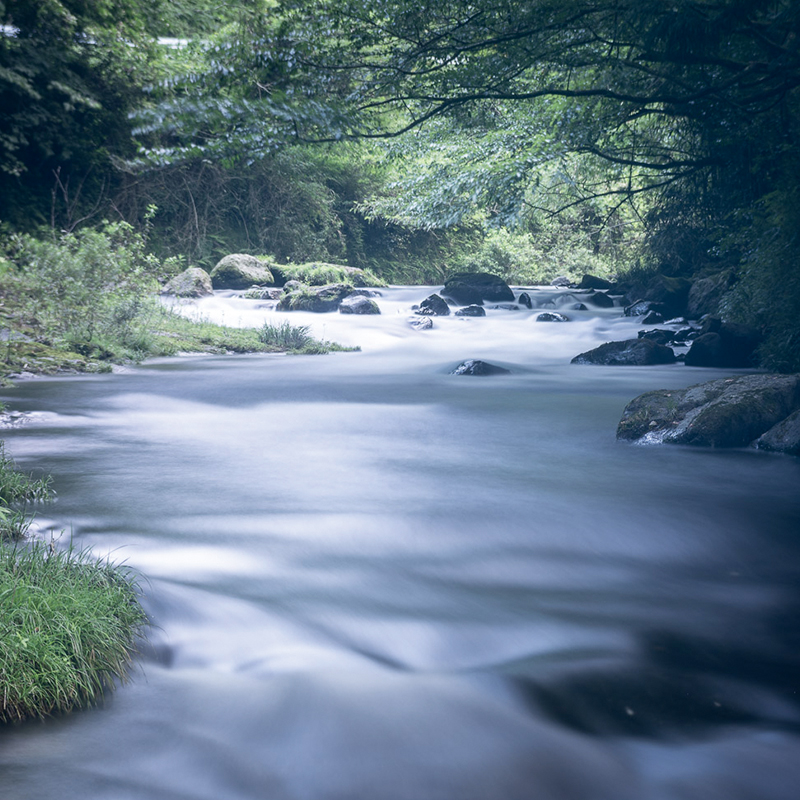
With its many rivers and location facing the sea, Kumamoto thrived on waterborne transport, which could move cargo faster and in larger quantities than land routes.
The Kengun Water Source, located near Lake Ezu.
The photo shows Well No. 5, one of 11 wells, from which enough groundwater springs up every day to fill approximately 40 swimming pools.
Why is it
so pure
and delicious?
“In Kumamoto City, all of our tap water supply is covered by groundwater. Because we use high-quality groundwater from the Kumamoto region, treatment prior to distribution to homes is limited to adding just the minimum amount of chlorine required by law.”
This was shared by Keisuke Yoshimura of the Kumamoto City Waterworks and Sewerage Service Public Corporation, who guided us through the Kengun Water Source, the city’s largest water supply site. How is such pure and delicious water created?
When rain falls onto the ground, it seeps underground and turns into groundwater. The groundwater flows slowly through the geological strata, being naturally filtered and refined over many long years. During this time, minerals and carbonic acid dissolve into it in a well-balanced manner, turning it into delicious, body-friendly natural water. Kumamoto is a place where this, so to speak, “natural mineral water” comes out almost as it is, simply by turning on the tap at home.
Furthermore, in Kumamoto City—where roughly 740,000 people, or over 40% of Kumamoto Prefecture’s population of approximately 1.7 million, reside—all tap water has been drawn from groundwater ever since the water supply system first opened in 1924 (Taisho 13). Out of an average daily consumption of 220,000 cubic meters, a full quarter—amounting to 60,000 cubic meters—is supplied by the Kengun Water Source located in the heart of the city.
“It is estimated that it takes about 20 years for Kumamoto’s ‘natural mineral water’ to reach the area around Lake Ezu in the city center from near the western foothills of Mount Aso’s outer rim, and about 5 to 10 years from the midstream area of the Shirakawa River. If you compare water drawn at Aso with water drawn here, the water here feels richer and smoother.”
The well water from the Kengun Water Source that Mr. Yoshimura poured into a paper cup after saying this was indeed rich in taste, soaking smoothly and pleasantly into the body.